15th January 2020
It has been exactly a week since we boarded the Magellan, and in that time, we have got to know our evening dinner companions reasonably well. Unlike the couple we shared a table with on our last cruise, who, as it happens, are also on this one, they have been unfortunate enough to be seated with what they describe as bores and social misfits.
We, however, share a table with two very interesting couples. Barry and Ruth, both in their youthful eighties, live in Bicester, not far from where Ken and Chris used to live before relocating to Spain. Occasionally, the conversation drifts to village pubs, theatres, and other local attractions they fondly remember from their younger years.
Barry was an engineer, rising to the position of chief engineer at Lucas before setting up his own small business restoring and repairing vintage cars. He and Ruth have clearly travelled extensively, and both have a wonderfully dry sense of humour. Barry, however, is quite unwell; he has lost 30% of his lung capacity, carries a nebuliser, and takes a considerable amount of medication each day. He quickly becomes short of breath with any activity. When he has occasionally missed dinner, Ruth wryly attributes it to his past smoking habit, remarking that he only has himself to blame.
Ken and Chris live in a large, secluded property in southern Spain. Ken previously owned an advertising and publishing business, which he sold to retire abroad. They love their life there and, unlike some of our other friends who have lived overseas, cannot imagine returning to the UK. They plan to downsize eventually, but will remain in Spain in a more accessible location. Ken took up writing to keep himself occupied and, by all accounts, has built a successful second career writing children’s books. On this cruise, however, he is hoping to finish a novel he started ten years ago. Good luck with that!
Both Barry and Ken share a passion for vintage cars, and their knowledge of the subject is phenomenal. Barry has an Aston Martin, while Ken has a frog-eyed Sprite (whatever that is). I, on the other hand, have a rather unremarkable Fiesta, and Sue has a Suzuki.
I don’t think we could have been seated with a better group of people. We are invariably the last table to vacate the dining room, often lingering past 11 pm, much to the amusement (and occasional exasperation) of our ever-cheerful waiters.
We arrived in the port of Mindelo (Cape Verde) during breakfast, with the first passengers allowed to disembark at 9 am once the necessary permissions had been granted. We had opted for a tour that would allow us to see more of the island beyond its capital, so our departure wasn’t until 10.30 am.
São Vicente is one of ten sizeable islands in the archipelago, with only one remaining uninhabited. Although all are volcanic, we were told that each has its own distinct character, ranging from lush and green to starkly arid. São Vicente is one of the latter, having received no rainfall for the past four years. The wet season, such as it is, falls between November and February. There are no natural watercourses; the last dried up centuries ago, so all food and water must be imported. Unsurprisingly, it is a very poor island, almost entirely dependent on tourism, with little in the way of viable exports or future economic prospects.
The islands were discovered and colonised by the Portuguese in 1462, flourishing as a key stopover for the slave trade. However, this was drastically curtailed by the British, who, in the 19th century, discovered coal on the island and exerted their considerable colonial influence. Their presence can still be seen in the island’s architecture and system of governance. At its peak, Mindelo was servicing 1,300 ships a year.
São Vicente is often described as having a wild and rugged beauty, harsh, dry, and barren. I wouldn’t disagree.
Our transport for the day was a rather basic 20-seater coach, lacking air-conditioning and with seats that were clearly not designed with the average European posterior in mind. We were part of a convoy, 12 coaches in total, setting off to explore the island.
After driving along the seafront for a brief glimpse of the fish market, local statues, and bustling side streets, our first stop was in the centre of Mindelo at the indoor craft and food market. Here, we joined a slow-moving crocodile of fellow passengers as our local guide introduced us to the market’s history and customs.
It was here that we bumped into Ken and Chris, who had sensibly opted to explore the town at their own pace rather than join the whirlwind tour during our short stay in port.

As we drove out of town, we caught fleeting glimpses of several historical landmarks that deserved closer inspection. However, as the title of our tour suggested, “A Glimpse of São Vicente”, we were getting exactly what we had signed up for.
Beyond the main town, roads were few and far between, but those that did exist were in far better condition than many back home. Private cars were a rarity, and the scattered settlements we passed looked decidedly ramshackle, mainly centred around fishing. Occasionally, there were signs that tourist money was beginning to make an impact, with the odd modern Mediterranean-style building standing out amidst the otherwise modest surroundings.
The landscape was undeniably rugged; towers of arid rock reached skyward across much of the island’s 16km by 4km expanse. Vegetation was almost non-existent, save for the occasional scraggy herb clinging determinedly to life.
Our next stop was Catfish Bay, a picturesque cove of golden sand and wave-lashed rocks. We were given a short time to wander and take photographs, and it was a welcome break to stretch our legs. The warmth of the sun, tempered by a cooling breeze, made for a far more pleasant experience than the cramped coach journey, where the scenery, if viewed through a pessimist’s lens, could be likened to a vast building site piled high with dusty rubble but devoid of buildings.

For most of the year, the island is battered by winds blowing in from the Sahara Desert, filling the air with fine dust. This is far from ideal for photographers, as any shots taken at a distance are blurred by the dry haze. More concerning, however, is the potential impact on asthma sufferers, for whom these conditions could eventually prove dangerous.
After hurriedly capturing a few photographs, we moved on just a short distance to a small cluster of tidy buildings, where we were offered drinks and snacks. The snacks were authentic local delicacies, reflecting the simple yet generous flavours of many of the cultures Sue and I have had the privilege of experiencing over the years. Of the various titbits we sampled, the ones topped with small slabs of goat’s cheese stood out, though mostly for their overwhelming cheesiness.
A selection of drinks was available: water, fruit juices, local beer, and Grog. Grog, made from fermented sugar cane, has an alcohol content exceeding 60% (though this varies), and I have no idea how it tastes. On this occasion, I wisely followed our guide’s advice and stuck to the beer. I do vaguely recall that pirates drank copious amounts of Grog, most of them developed raspy voices, and many came to a rather sticky end.
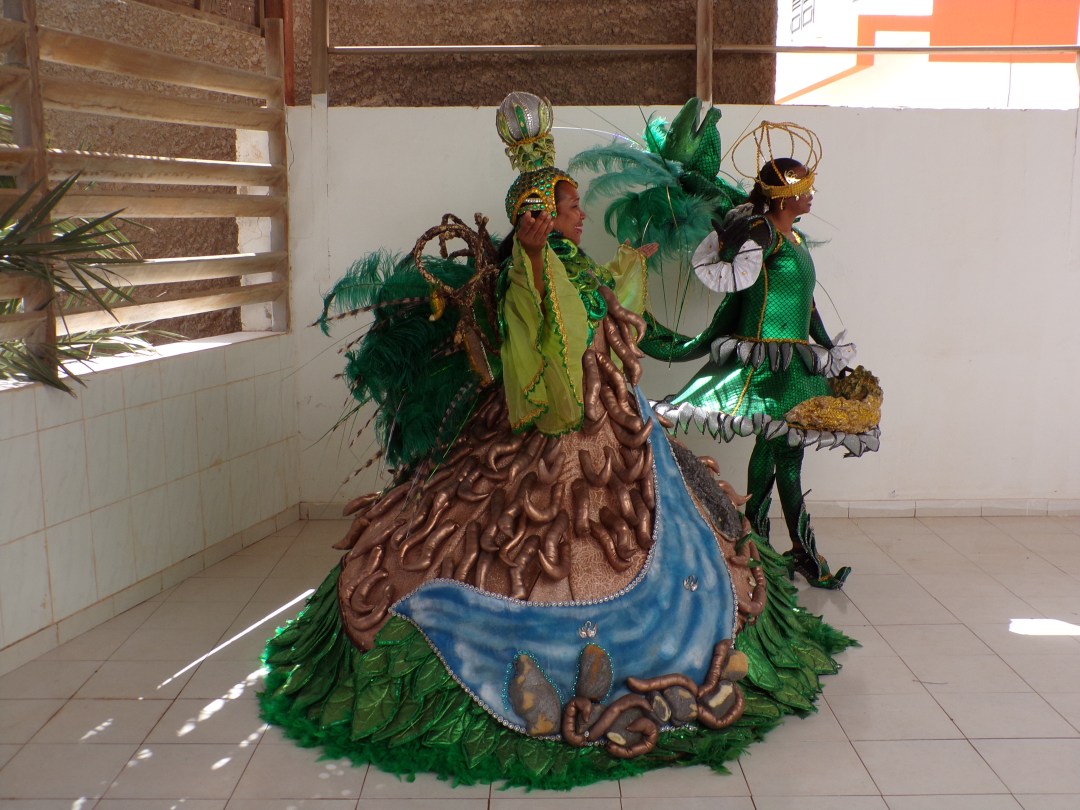
Two outlandishly dressed ladies, draped in elaborate green costumes, struck dramatic poses for our photographs. They were certainly not wearing traditional local dress; I guessed that, given the island’s enthusiasm for Carnival, these outfits were inspired by the festivities.
As we nibbled on our snacks, we were treated to further entertainment, a three-piece band accompanied by two couples in much simpler attire, gracefully performing a series of dignified reels. This, unexpectedly, turned out to be the highlight of my day.
And, for the record, I definitely didn’t touch the Grog!

As the slower buses in our cavalcade caught up, we moved on, first stopping at another beach, then again to walk across some dunes, before leaving the tarmacked highway for a cobbled route that wound its way precariously up one of the mountains.
The aim was to take in a breathtaking view of the island, particularly Mindelo and our cruise ship. However, as previously mentioned, the Sahara and the prevailing winds have a significant influence on the island’s climate, meaning there can’t be many days in the year when tourists, bouncing up this mountain in grunting, diesel-spewing buses, actually get a clear view of anything.
We certainly didn’t!


We arrived back at the ship 25 minutes later than scheduled, though most of our convoy had yet to return, so it was no surprise that we departed port behind schedule.
Thoughts on São Vicente: Despite being a poor island, its inhabitants are welcoming, cheerful, and relaxed. I imagine that spending any length of time in their company would be an experience to treasure. However, the island they call home severely limits their opportunities. They are eager for more visitors from around the world, more importantly, visitors who will spend money and help raise their standard of living.
A direct comparison can be made with Fuerteventura, which also relies entirely on importing its water and food. Yet, being much closer to prosperous Europe, it attracts financiers and hotel chains that recognise the value of location and climate in the travel industry. Unfortunately, the level of investment needed to make São Vicente profitable for mass tourism seems too great.
There are plans to build a five-star, all-inclusive hotel complex on the island, but who would come? Certainly not those with asthma, given the island’s dusty conditions, nor the more adventurous travellers, who tend to avoid all-inclusive resorts. We saw the best São Vicente has to offer, and, frankly, there isn’t much beyond a subsistence-level existence and a very basic infrastructure. While this simplicity may appeal to some, such visitors rarely bring the kind of spending power needed to drive significant economic change.
Even the locals are sceptical of the proposed hotel, recognising that the profits would likely flow abroad rather than into their economy.
We spent just five hours on the island, and sadly, I must conclude that it lacks enough to entice discerning European travellers beyond a brief visit. Perhaps the African market could prove more viable, or even the Chinese, who seem to have economic interests here as well. I wish them luck, but Sue and I won’t be returning.


Leave a Reply